A private AI agent on Telegram, sealed in the EU, for $20/mo.
Same price as ChatGPT Plus. None of the “your messages train our models” risk. None of the OpenClaw install hell. Subscribe, connect Telegram, ship.
Why this exists
ChatGPT Plus is brilliant. It also runs in US datacenters where the operator can technically read your messages, and where “don’t train on my data” is a policy toggle rather than a hardware guarantee. For most uses that’s fine. For a lawyer pasting a contract, an accountant pasting a tax return, or a clinician pasting a patient note, that’s a regulator’s dream and your nightmare.
OpenClaw solves the trust problem by letting you run an agent locally with your own keys. But the install is brutal: Node v22.16.0 specifically, nvm, terminal access, hand-edited JSON config, BYO LLM API key, 92 plugins loading on cold start. The README literally tells non-technical users to walk away. Hundreds of thousands of GitHub stars, a tiny fraction of finished installs.
From zero to chatting in 3 minutes
No CLI. No config file. No Node version manager. The hosted version exists precisely because the self-host path eats hours and a meaningful fraction of would-be users never finish.
Subscribe
Plus tier, $20/mo via Stripe. Cancel anytime, full refund within 7 days.
voltagegpu.com/confidential-agent → SubscribeConnect Telegram
Click the deep link in your dashboard. Telegram opens. One tap binds your account.
t.me/voltage_personal_bot?start=<your-token>Start chatting
Send any message. Cold start ~2s. Inference runs inside a TDX enclave, sealed by the CPU.
/help to see all commandsEight things you’ll actually use
Every example below is a real Telegram exchange. The bot replies with markdown (bold, code blocks, lists) so the formatting survives in your chat history.
Long-form drafts
Contracts, briefs, reports, proposals. Paste your inputs, get a structured first draft.
Saves ~45 min per draft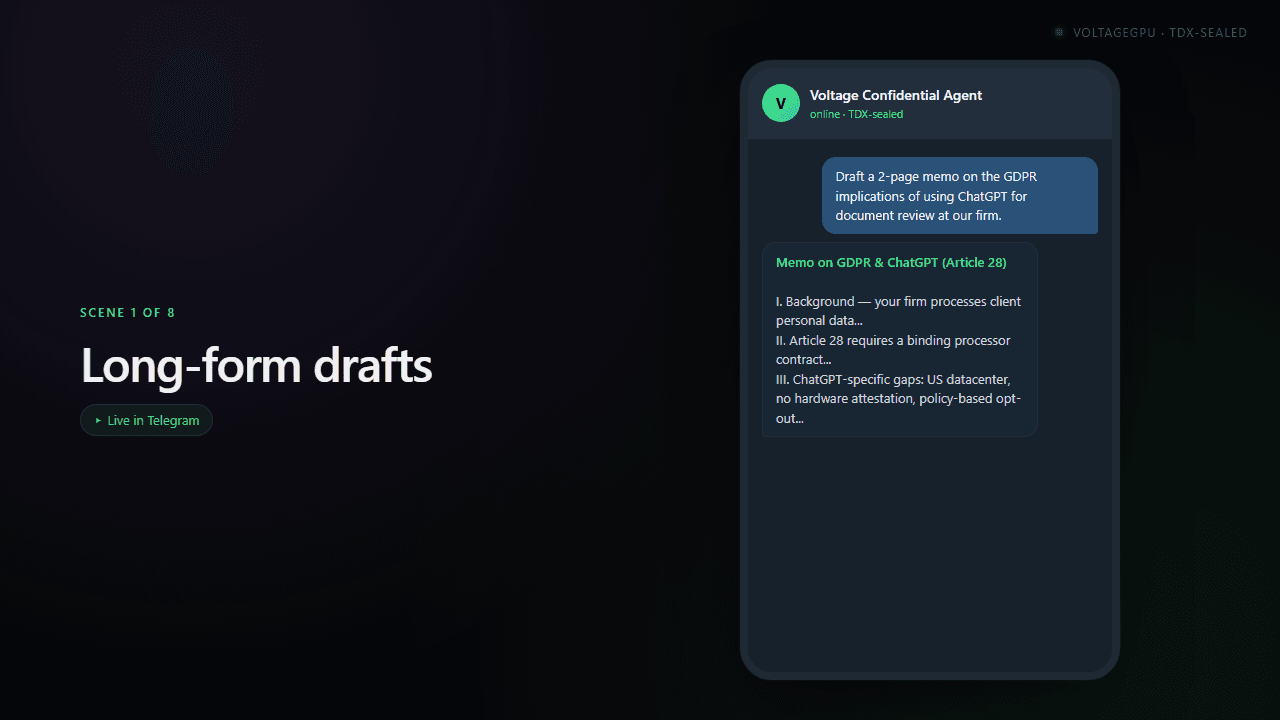
Document analysis
Upload a PDF or paste text. Ask anything, summary, risks, missing clauses, contradictions.
Saves ~30 min per doc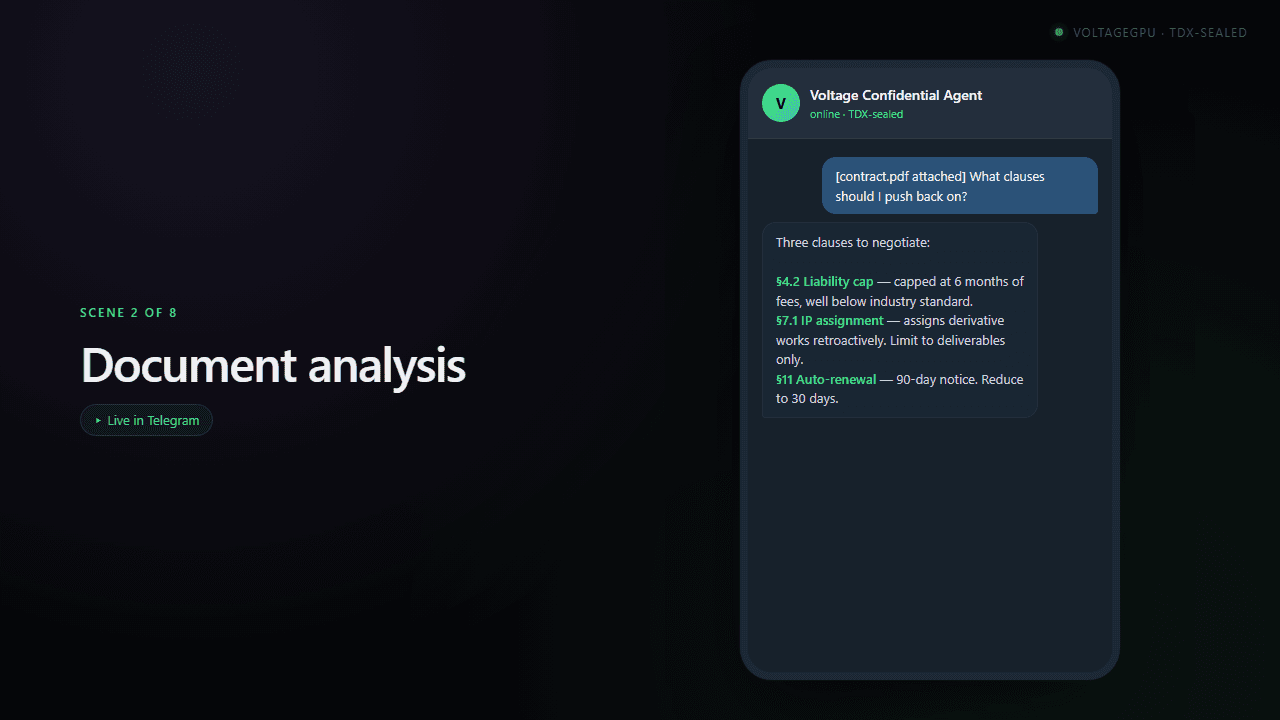
Email drafting
Reply to a paste. Tone control: formal, friendly, firm. Translate as you draft.
Saves ~3 min per email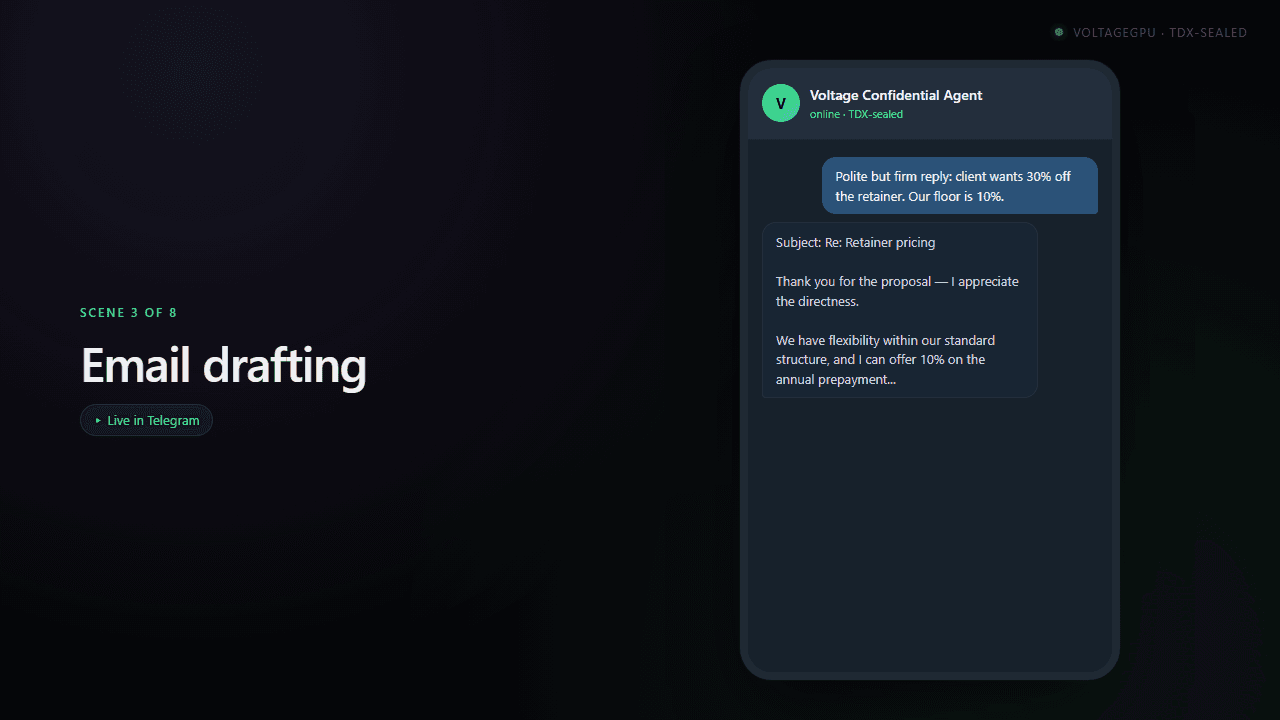
Code review & generation
Paste code, get a review. Describe what you want, get a working snippet. SQL, Python, TS, Go, Rust.
Saves ~20 min per review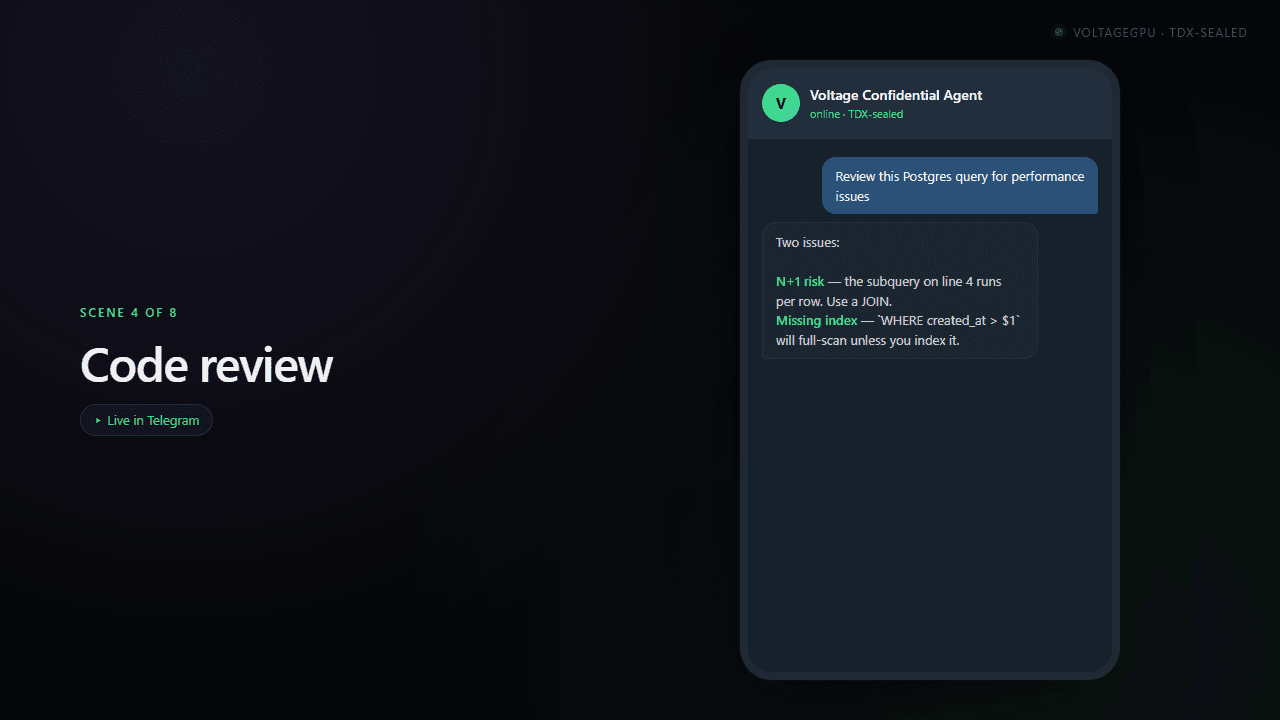
Research with citations
Ask a real question. Get a structured answer with source links. Web access via search plugin.
Saves ~25 min per topic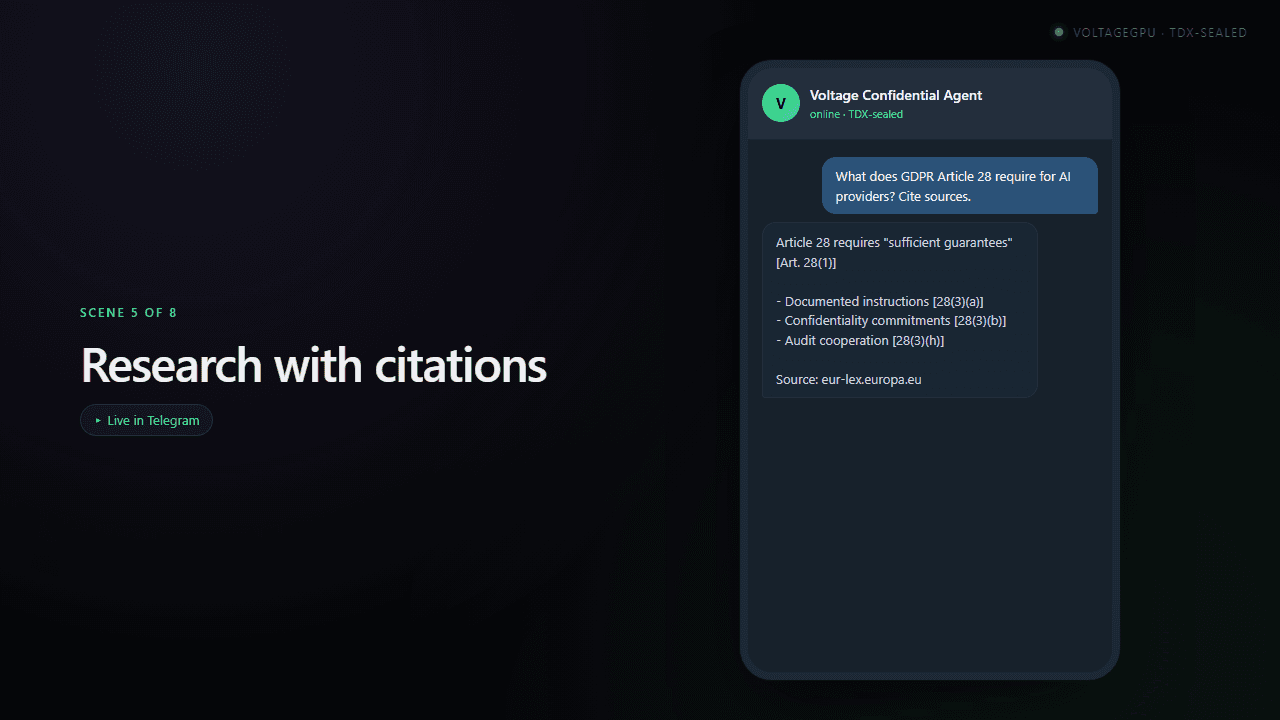
Translation (12 languages)
Native-quality between EN/FR/DE/ES/IT/PT/RU/JA/KO/ZH/AR/HI. Preserves tone and legal terminology.
Saves ~15 min per page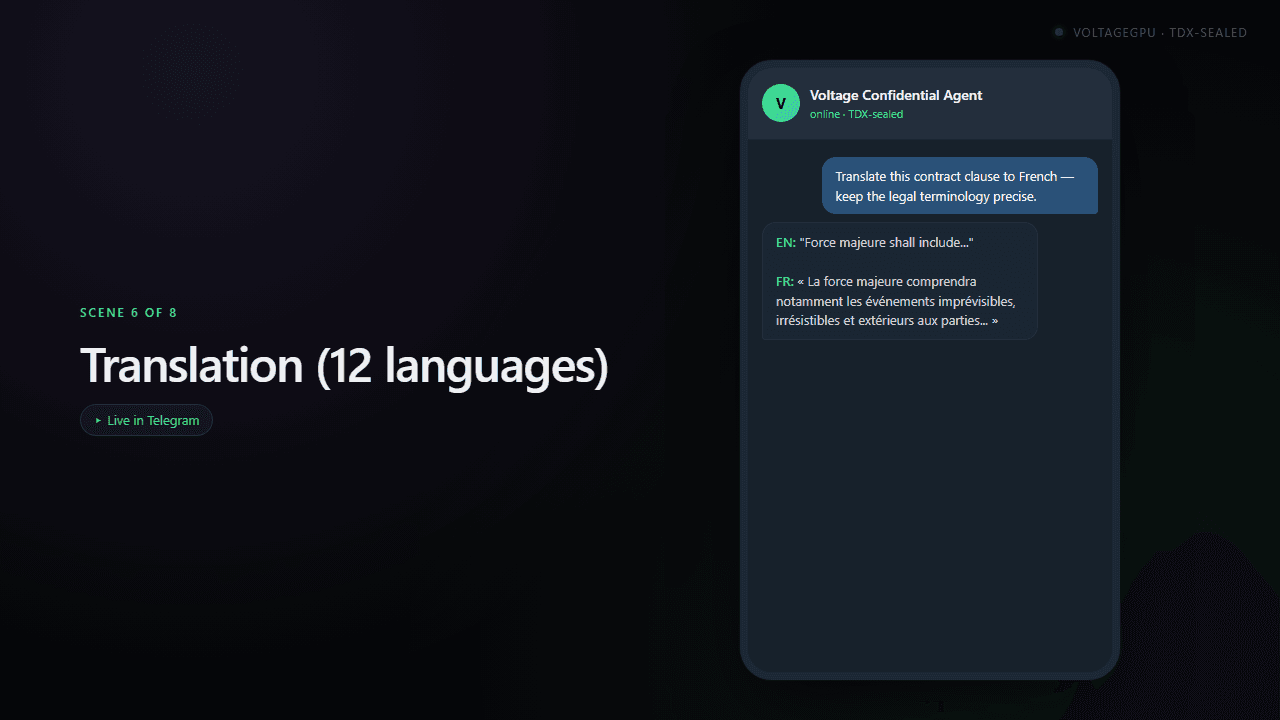
Voice-to-text (Telegram native)
Send a voice message. Get transcript + summary back. Useful for meeting notes on the go.
Saves ~10 min per recording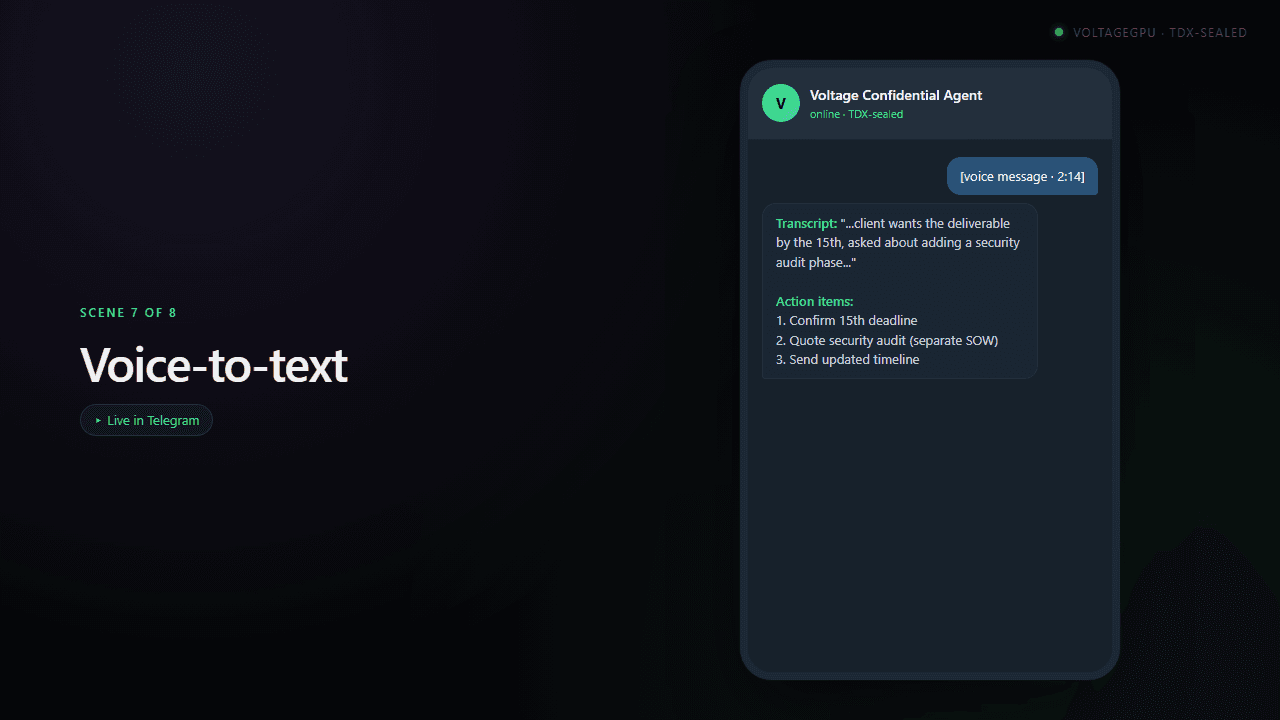
Conversational memory
Remembers previous messages in the same chat. Pick up where you left off without re-explaining.
Always-on context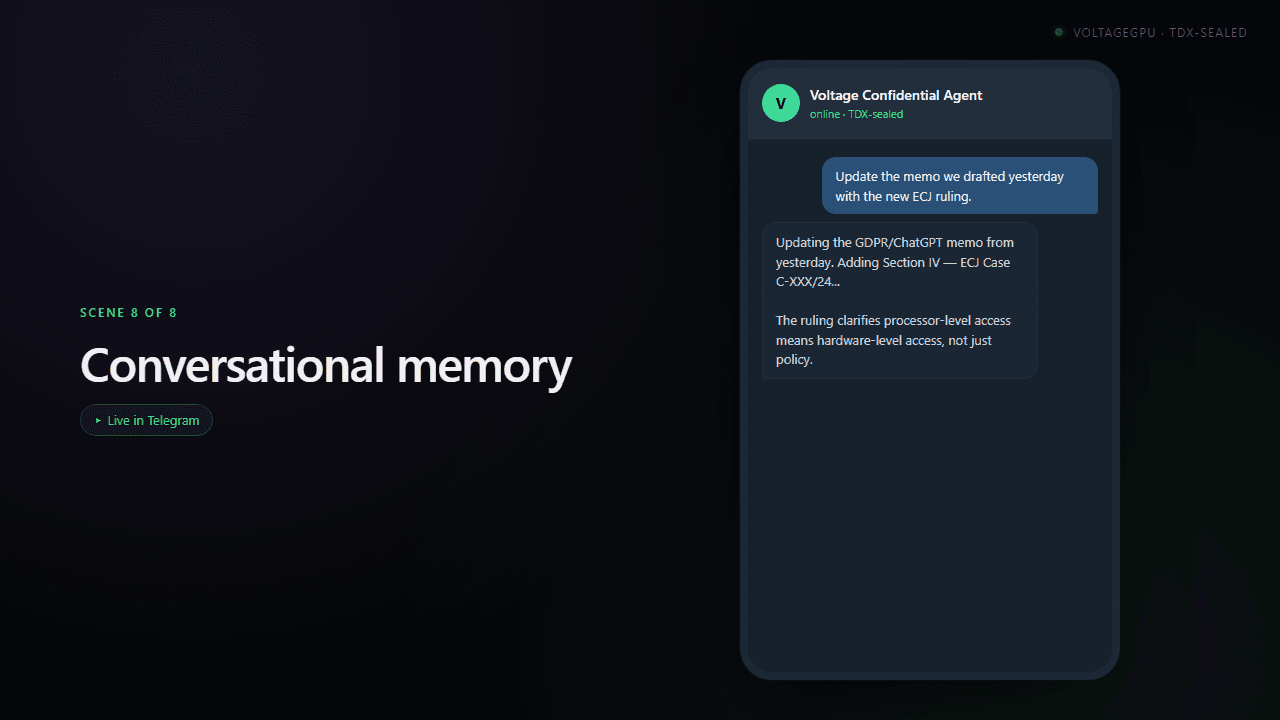
What’s the break-even for your role?
The honest answer: if the agent saves you more than 8 minutes a month at any professional rate, you’re ahead. Move the sliders to your reality.
ROI calculator
Drag the sliders. Math is live.
vs ChatGPT Plus & self-hosting OpenClaw
Three options sit in the same price bracket. Here’s the trade-off matrix.
| ChatGPT Plus | Self-host OpenClaw | Confidential Agent | |
|---|---|---|---|
| Monthly cost | $20 | $0 + your LLM API costs | $20 |
| Setup time | ~2 min | Hours (often abandoned) | ~3 min |
| Hardware-sealed memory | No | Yes (your hardware) | Yes (Intel TDX, EU) |
| Trains on your conversations | Policy toggle | Never | Cannot, CPU-enforced |
| Data residency | US | Wherever you run it | EU (France) |
| Telegram interface | No | Build it yourself | Native |
| Plugins / tools | OpenAI app store | 92 plugins (full ecosystem) | Curated subset (audited for TDX) |
| Local file access | No | Yes | No (enclave is remote) |
| GDPR Art. 28 DPA | Generic | You are the processor | Hardware-attested |
| Maintenance burden | None | Updates, plugins, model swaps, you | None |
Honest take: if your work hinges on a 92-plugin ecosystem and direct local file access, self-hosting wins. For everyone else, especially anyone who handles client personal data, the hosted Confidential Agent gives you the privacy guarantees of self-hosting without the install nightmare.
Why “Intel TDX” is more than a buzzword
Software-encrypted services protect data at rest (on disk) and in transit (over the network). But during inference, data must be decrypted in memory, where any sysadmin with root can technically read it. Most cloud providers are honest, careful, and won’t. But “won’t” is a policy. “Can’t” is a guarantee.
Intel Trust Domain Extensions (TDX) add a third state: encryption in use. The CPU generates encryption keys that no software, not the hypervisor, not the BIOS, not the host OS, can access. Memory pages used by the enclave are encrypted with AES-256 at the hardware level. trust-domain GPU isolation extends this to the GPU.
The result: VoltageGPU staff cannot read your messages. We can prove it via remote attestation, the CPU signs a quote that includes the enclave measurement, which you can verify against our published reference values. If we tampered with the runtime, the quote would diverge and the attestation would fail.
Verify it yourself: step-by-step attestation guide.
Questions people actually ask
How is this different from ChatGPT Plus?
Same price. Different threat model. ChatGPT Plus runs in the US on shared infrastructure, operators can technically read memory, and conversations train the model unless you toggle off. Our agent runs inside an Intel TDX enclave, sealed by the CPU. Memory is encrypted with AES-256 at the CPU level. Even VoltageGPU staff cannot read your messages, the CPU enforces it, not a policy.
How is this different from self-hosting OpenClaw?
OpenClaw self-hosting requires nvm, Node v22.16.0 specifically, terminal access, JSON config with no schema validation, and your own LLM API key. Cold start loads 92 plugins (~90s). Our hosted version skips all of that, subscribe, connect Telegram, done. You lose direct local file access but gain instant setup, EU-hardware-sealed inference, and zero maintenance.
What model runs under the hood?
Qwen3-32B-TEE, comparable to GPT-4 mini on most reasoning benchmarks, MMLU 79.5, HumanEval 81.2. The "-TEE" suffix means it runs inside a Trusted Execution Environment (Intel TDX). Inference latency: ~755ms TTFT, ~120 tokens/sec on H200. TDX overhead: 3-7%.
Will my conversations be used for training?
No. No software on our side can read them. The TDX enclave encrypts memory with keys held only by the CPU. We have no logging on inference traffic by design. If we wanted to train on your data, we would have to break the enclave, which would invalidate the hardware attestation and be cryptographically detectable.
What is the realistic ROI for a professional?
Average user reports 12-18 hours saved per month on drafting, research, and document review. At a billable rate of €150/hour, that is €1,800-€2,700 in recovered time for a €20 subscription. Break-even is 8 minutes per month.
Can it access the internet? My local files? My email?
Internet: yes, via search plugin (curated, audited). Local files: no, the enclave is remote, it cannot reach your laptop. Email: not yet (planned Q3 2026, IMAP read-only with explicit per-mailbox consent).
What languages does it speak?
Twelve native: EN, FR, DE, ES, IT, PT, RU, JA, KO, ZH, AR, HI. Mixed languages in one conversation work, it auto-detects per message.
Is there an API or just Telegram?
Telegram is the primary interface for the Plus tier ($20/mo). Direct OpenAI-compatible API access is available on the Confidential Inference plan (separate product, usage-based pricing). Many users use both, Telegram for personal, API for product integrations.
What if I cancel?
Stripe self-serve. Your data is purged within 24 hours of cancellation (we keep no chat history beyond the active session anyway, since the enclave does not persist memory after each request).
Why Telegram and not WhatsApp / Signal?
Telegram has the cleanest bot API and best support for long messages, voice, and file uploads. WhatsApp Business API is heavily gated by Meta. Signal does not support bots. We use Telegram for the interface, but inference still runs in our Intel TDX enclave, not on Telegram servers.
Try it for the price of a ChatGPT Plus subscription
Same $20/mo. Stripe self-serve. Full refund within 7 days if it doesn’t click. Setup takes about as long as reading this paragraph.